If the images do not appear in due time, please refresh/reload the page.
ジャポニスムに関する
大学の講義資料
Japonisme Theory and Architecture
University Lectures, Manuscripts, and Notes
Due to the constraints of time and circumstance, much of the following material must unfortunately remain in unfinished form, or otherwise perhaps never see the light of day. Even then, at the present pace, only a small portion, at best a few percent of the accumulated manuscripts, notes, and scrapbook ideas over the past 40 some years can possibly be covered on the pages of this website, which was created in September of 2021 (and the museum itself in 2020), so that at least some of those ideas and discoveries might be finally shared with others. The follwing papers may be quoted (with the understanding that many are in draft form and will undergo revisions) and the author asks that credit be given for the sake of the record, so that others can understand where ideas come from, and so as to not repeat in another way the silence regarding japonisme---for in scholarship more so than in art, the Japanese contribution has not been justly appraised.
Photo: east facade of The Japonisme Museum, Kyoto Japan
JAPONISME THEORY
From lecture material given at Kyoto University by Yasutaka Aoyama, 2015/8/5
Uploaded 2021/10/5
4 Mechanisms of Design Influence
Here are 4 primary methods by which traditional designs are adapted and incorporated into new architectural structures and art forms. More than one of these methods of adaptation can occur simultaneously, and occasionally all four processes may be involved in the creation of new designs.
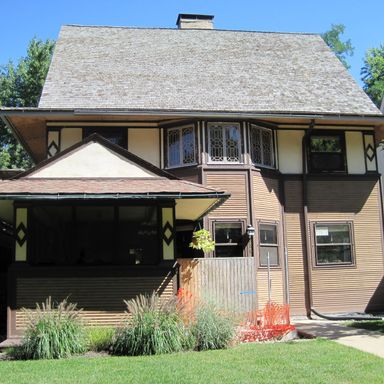
Above: Frank Lloyd Wright, roof forms of the World 1893 Exposition Hooden, reflected in the Harry C. Goodrich House, Oak Park, Illinois, 1896.
Arithmetic & Surgery
Changes by substitution, addition, or subtraction of architectural elements. The process may be considered a form of surgery, either grafting/ implanting/transplanting vs. excision/ extraction/ablation; or otherwise minor cosmetic surgery. 'Cut and paste', 'mix and match', would also be common expressions of this approach.
Examples: Addition/Grafting, 1) Frank Lloyd Wright's Harry C. Goodrich House, front exterior, left side with Japanese style roof. 2) 17th century Japanese lacquered chests fitted with European style legs (sometimes referred to as 'comptoiren'). 3) Peter Behrens electrified Japanese style hammered tea kettles. Subtraction/Excision, 4) Ludwig Mies van der Rohe's 'deroofed' Crown Hall. Substitution /Mix and Match, 5) Émile Gallé's ornamental porcelain fan of roosters fighting (1878, Musée de l'École de Nancy) with a fleur de lis and French words added to a traditional Japanese design.
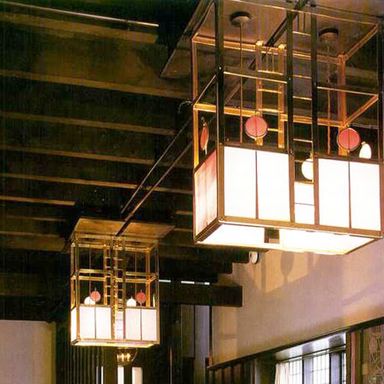
Above: Charles Rennie Mackintosh, ceiling lighting fixtures for Hill House, 1903 much like floor andon turned upside down.
Inversion / Rotation
and other Transpositions
Changes in scale, dimension, direction, or proportion. The proces may be considered a type of reversal, inversion, or rotation; e.g. turning the source object upside down; or inside out where interior features become exterior features and vice versa; or 'flipping over and free tracing' as in mirror image drawings, or rotating the image 90 degrees, rather than 180 degrees. Other inversions include 2D <---> 3D; big <---> small; light <---> dark.
Examples: Reversal/Vertical Inversion, 1) Charles Rennie Mackintosh's ceiling light fixtures at the Hill House, inverted floor lamps. 2) Otto Wagner's Court Pavilion, 1898, interior painting of a eagle hovering over a landscape, in low position in reverse from Hiroshige's high positioned eagle in his 'Jumantsubo' print. Mirroring/Horizontal Inversion, 3) John Romita Jr. (Marvel Comics) cover for King Size Annual X-Men #4 1980 mirroring Utagawa Yoshitsuya's 'Princess Takiyasha Bewitching'. 4) 2D to 3D, Camille Claudel's 'Wave' at the Rodin Museum.
Above: Frank Lloyd Wright, the United States Embassy project, Tokyo, 1914, mimicking the layout and style of Heian Jingu.
Conversion & Redefinition
Change of media/ material/ art form, nomenclatsure or functionality. This process may be considered a kind of transmutation, metamorphosis, redefinition, or translation (i.e. a change in the cultural idiom). Think of when a chopstick is used as a hair pin, or wood structures being replicated with concrete. Features of shape and ordering are recognizably the same, without substantial changes in the outlines of the design, but the result is something readapted/converted, serving a new function, or renamed and serving the same function, This includes linguistic and cultural translation of the subject matter; i.e., a change of language scripts or subjects in a Japanese setting changed to a European setting, but the composition, poses, etc. are essentially preserved according to the original.
Examples: 1) Rennie Mackintosh's 'Kimono Cabinet' mimicking a kimono on rack form. 2) Frank Lloyd Wright's The United States Embassy project, a change from religious to secular function. 3) Edward Godwin's 'Kinkakuji' style secretary desk. 4) Auguste Perret's Theatre des Arts Decoratifs interior design and details from wood to concrete. 5) Paul Signac's porcelain pattern painting of Felix Feneon. 6) Ferdinand Hodler's painting 'Le grutli moderne' from Utamaro's 'ryogokubashi zume'. 6) Renaming the same form, such as chrysanthemums to sunflowers.
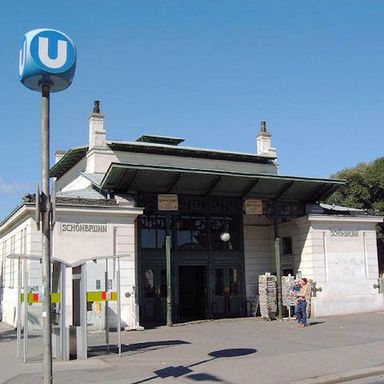
Above: Otto Wagner, Schonbrunn Station, 1896 reminiscent of Japanese castle gate architectonics, e.g. Nijojo Higashi Ootemon.
Abstraction vs. Elaboration
Changes in the degree of detail, complexity, or clarity. This process may involve an abstraction of the core architectural form via simplification; or otherwise an elaboration of it with ornamental detail. In either case, the overall underlying architectonic form is maintained, though it may involve a change in proportions or some form of deformation, or at times both processes may be at work, e.g., elaboration by an overlay or mesh of one abstracted image over another.
In the case of abstraction, there is a shearing away of decorative elements, of the superflous, with a pronounced emphasis or exaggeration of the core concept. Elaboration involves a dressing or costuming of the decorative exterior/interior. Examples: Abstraction, 1) Frank Lloyd Wright's George D. Sturges House, California, from Kiyomizudera. 2) Mies van der Rohe's Barcelona Pavilion as an abstraction of Ryoanji. Elaboration, 3) Otto Wagner's Schonbrunn Railway Station as a re-costuming of a Japanese castle gate. 4) Charles Rennie Mackintosh and Margaret Macdonald's wall paintings and ornaments for the Willow Tea Rooms, meshing two forms of Japanese art.
Uploaded 2023/9/26 Under construction
Theory Related Articles on this Website
The JAPONISME MUSEUM Newsletter = JMN; Architectural Japonisme I-V = Arch J; 16th-18th Century Japonisme = 18th C J; Literary Japonisme = LC; Museum Exhibit Card = MEC
Titles of articles abbreviated, see the webpages for further details. Articles chosen if an aspect of the relevant topic is discussed. Their content may be related to multiple topics listed below.
PROCESSUAL JAPONISME
Arithmetic & Surgery
Behrens Early 20th Century Japonisme in Architecture and Industrial Design in Germany Arch J
Johnson From Modernist Subtraction to Post-Modern Addition Arch J
Inversion & Rotation
Yoshitsuya The 'Gaping-Monster-Mouth Entrance' A Case of Horizontal Inversion JMN
Kuniyoshi Explaining the Mechanics of Japonisme Influence: Inversion and Reversal JMN
Conversion & Redefinition
Perret A Translation and Transplantation of Japanese Tectonic Qualities Arch J
'Le Corbusier' Japonisme & The Apotheosis of Charles-Edouard Jeanneret Arch J
Mackintosh Functional Readaptations of Japanese Designs Arch J
Abstraction vs. Elaboration
Mies van der Rohe Modernism as the Abstraction ('De-roofing') of Kyoto Palaces and Temples (Abstraction) Arch J
De Stijl Composition, Color, Detail--and the Japanese House (Abstraction) Arch J
Eames Adapting the Japanese Outlook on Life to the American West (Abstraction) Arch J
Mackintosh Transmutation, Intertwinement, and Overlay (Elaboration) Arch J
Metonymy & Magnification
Kunisada Metonymy and Magnification Part I JMN
Kuniyoshi Metonymy and Magnification Part II JMN
Family Resemblances and Artistic Extrapolation
Ishinomori Family Resemblances and Artistic Extrapolation in ‘Monster Japonisme’ JMN
Depiction Techniques: Energy
Hokusai The Iconography of Combustion JMN
Yoshitsuya The Japonisme of Beams, Rays, and Streaking Bullets JMN
Kiyomasu Breaking Through to Other Worlds and the Japonisme of ‘Impact Splotches’ JMN
Depiction Techniques: Gender and Age
Harunobu Billowing and Bounding Beauties & Depictions of Female Power JMN
Ishinomori Obliqueness, Softness, and the Early Japonisme of Manga-style 'Kawai' JMN
Rossetti Utamaro and the Pre-Raphaelite Discovery of a New Feminine Ideal Arch J
Depiction Techniques: Perspective and Composition
The Japanese Origins of Axonometric Projection in the Fukinuki-yatai Arch J
Design Transmission Theory
Hokusai Direct vs. Indirect Transmissions of Supernatural Force and Energy JMN
Rietveld The Okoshi-e Design Process Arch J
JAPONISME EPISTEMOLOGY
Reality vs. Image of Japanese Aesthetics
Stick Style II Incorporating Japanese Style Symmetry and Asymmetry into American Design Arch J
Venturi The Japonisme of Complexity & Contradiction Arch J
Hoffmann The Japonisme of the Bold Right Angle Outline Arch J
Horta Following the 'Iki' of the Organic Japanese Line Arch J
Tea Ceremony Aesthetics in the Texture of Abstract Art Cross-cultural & Trans-media Influence ( in Exhibiting Japonisme)JMN
Nevelson Reconstituting Debris / Reinterpreting Artifacts Sculptural Japonisme
Edo and Meiji Textures in Abstract Art & Photography MEC
Queen Anne Style The Japonisme of Unpredictable Complexity and Full-Color Ornateness Arch J
Japonaiserie vs. Japonisme
Kiyomasu Japonaiserie as Overlay / Japonisme as Underlay JMN
Marie Antoinette Lustrous Lacquer of the 16th~18th Centuries Sparking the Picturesque and Romantic Imagination 18th C J
Origination Theory
Hokusai Japonisme as Big Bang Theory of Comic Art JMN
Cubism as a 2-Dimensionalizing Origami Conceptual Transmutation / 'Gestalt' Arch J
Murano Rethinking Post-Modernism's Origins Arch J
Gilpin The Case for the 18th Century Sino-Japanese Origins of the 'Picturesque' Arch J
Huygens The 17th Century Japanese Origins of the Picturesque in Garden Design 18th C J
Historical Conceptualization and Japonisme in World History
Michener and the Japonisme Renaissance (1955-1985) LC
Japonaiserie as Concurrent with Chinoiserie in the 17th and 18th Centuries 18th C J
Japan as a Symbol of the Ultra-Modern in Design, 1890-1915 Arch J
Curation, Museology and Japonisme as a Discipline
Exhibiting Japonisme JMN
Monet Japonisme Micro-Analysis: Pinpointing Correspondences and Brush Stroke Details JMN
ARCHITECTURAL JAPONISME
Japonisme, it will be argued, was the necessary and primary impetus for the Modern Movement, otherwise known as Modernism, in a broad spectrum of art forms from the late 19th century onward to the present, including architecture. For that reason, it can be shown that virtually all of the best-known architects exhibit markedly Japanese design characteristics, in at least some of their works, if not most of them.
Furthermore, many, though not all modern architects, have clearly stated the strong influence of Japan on their work, and a large body of biographical and design specific research attests to this. Nevertheless, this japonisme interpretation is diametrically opposed to the mainstream, generalized historical interpretation, held East and West, as to the key underlying influences leading to the rise of modern architecture, as well as the design trends that ensued. That is to say, the present paradigm of modernism as something fundamentally 'home-grown’ is firmly entrenched. It is reinforced by survey works for the general public as well as by university graduate school courses for the budding architect, and with a dogmatic fervor no less passionate than that of Catholic Church proponents of the pre-Copernican view of the universe in the early 17th century. And now, with the tools of modern mass media and publishing, it is a paradigm perhaps even more difficult to 'shift' than then.
The orthodox interpretation of the origins of architectural modernism are based upon a mixture of abstractions---philosophical, social, technological and artistic---somewhat reminiscent of the geocentric Ptolemaic system in its artful complexity, combined with a spectacular, honor roll-like continuum of original, individual genius. These factors however, are never sufficient causes to explain the specific combination of aesthetic qualities and shapes that arose to become ‘the modern.’ Japonisme, as an explanation, on the other hand, offers more concrete events, ready-made analogous conceptions/structures to the modern, as well as highly specific, identifiable matches of individual designs or design elements to those Japanese in almost innumerable quantity. In other words, the influence of Japan is a conclusion that one arrives at after an overwhelming amount of repeated indications, which initially are dismissed, only to continue to appear in a wide range of cases so that even the 'cognitive dissonance' arising from such a hypothesis must be confronted. Then, when investigated systematically, it is further confirmed. That is to say, it is a conclusion that is more inductively based, while the reigning interpretation is more deductive in nature.
Having stated that, Japan was more than a treasure trove of identifiable, prototypical images, techniques, and set conceptions. Surely it can also be proposed that the example of Japanese art, with its relative freedom of line and variety of forms, acted as a general catalyst in setting the architectural imagination free to experimenting with a greater variety of shapes and themes, just as it did for other art media in the West and elsewhere in the world. That is, architectural japonisme was not only the direct influence of Japanese architecture (both traditional and modern) on worldwide architectural design; Japanese art and crafts, and aspects of intangible culture in a conceptual sense, stimulated design motive at the 'parti' level---at the point of origination; as well as providing ideas for finishing touches.
The small sampling of cases provided below will hopefully provide a start with which the reader might rethink the assumptions and interpretations put forth by the present-day mass media which surrounds him.
Architects and artists/writers associated with them influenced by Japanese art or architecture (those without parentheses are architects) that are discussed in parts I to VII:
Aalto; Asplund; Utzon; Libeskind; Deleuze (philosopher); C. and R. Eames; Loos; Mondrian (painter); Rietveld; Oud; Wils; Huszar; Kiesler; Gropius; Itten (teacher); Voysey; Greene and Greene; McKim, Mead and White; F. Kimball; Sullivan; Guimard; André; Sauvage; Weissenberger; Charbonnier; Mackmurdo; D. Newton; R. M. Hunt; Cram; Lamb and Rich; Twain (Clemens, novelist); E. Potter; F. Butterfield (chief carpenter); Richardson; Webb; Morris (designer); Madox Brown (painter); Crane (illustrator); Byrne-Jones (painter); Burges (painter), de Morgan (ceramicist); Ashbee (designer); Shaw; Mackintosh; O. Wagner; Behrens; Perret; Godwin; D.G. and W. Rossetti (painter, critic); Peabody and Stearns; Horta; Endell; Venturi; Coates; Mies van der Rohe; Hoffman; Moser (designer); Olbrich; Nesfield; Jeckyll; Gill; Maybeck; C. Alexander (architectural theorist); Frampton (architectural historian); Pallasmaa; Le Corbusier; Perriand; Grasset (designer); L'Éplattenier (teacher); Ritter (painter); Hodler (painter); Morse (writer); Sturzenegger (painter); Mendelsohn; van de Velde; P. Johnson; C. Moore; Jencks (architectural theorist); T. Ungerer and A. S. Yöndel; Klemmedson; Thiry; H. H. Harris; Wright; V. Ossipoff; Neutra; G. Snyder (poet); C. W. Callister; Vernon Demars; Gensler Associates; R. Brockob; Hiroshi Sakaguchi; David Putnam (carpenter); Len Bracket; David Takamoto; David Graeber; Al Klyce; Stephen Macdonald; J. Charney; Charles Wong; John Harvey Carter; S. Ehrlich/EYRC; Henry Smith-Miller; Peter Shelton (artist); Andrew Herbert; George Nakashima (artist); Pacifica (Harry Jackson's furniture company); Kaneji Domoto; J. Eichler (developer); John Rex; Christopher Robertson; R. Schindler; Durisch & Nolli; M. Gautrand; AR+TE; Fran Silvestre; Carlos Ferrater; NMD|NOMADAS; Belzberg Architects; S. Calatrava; Office Kovacs; Mario Cucinella; Niall McLaughlin; Coll-Barreu; Studio Gang; Daanilo Mondada; HHD_FUN; Preston Scott Cohen; Rojkind Arquitectos; Moneo Brock; NORD; Harrison and White; Dominique Coulon; Cobaleda & Garcia; Jürgen Mayer; J. Nouvel; Bjarke Ingels; Aranguren & Gallegos; Coop Himmelb(l)au; Henriquez Partners; CrystalZoo; McBride Charles Ryan; ATI Consultants; Justo Garciá Rubio; Z. Hadid; Gigon/Guyer; Paleko Arch Studija; E. Musk (entrepreneur); P. Frankl (designer) and others.
Mentioned by other authors as influenced by Japanese art or architecture in Part I include: Mayne of Morphosis; E. O. Moss; F. Israel; and others listed above (noted by J. Steele). In Part II: W. Deininger; Karl von Keler; C. Witzman; P. Engelmann; E. A. Plischke; not to mention a slew of notable painters, graphic designers, and artisans (by editors of Japonisme in Vienna).
See Architectural Japonisme VII, concluding section, regarding architects for future discussion.