Pierre-Auguste Renoir's Peculiar Japonisme
Both Superficial and Profound?
From 'Japonaiseries' to the Absoption of Kogei Sensibilities
and Conceptualizations of Art Awakened
“Old Corot opened our eyes to the beauty of the Loing, which is a river like any other; and I am sure that the Japanese landscape is no more beautiful than other landscapes. But the point is that Japanese painters knew how to bring out their hidden treasure."
Auguste Renoir in Renoir, My Father by Jean Renoir (1962:222).
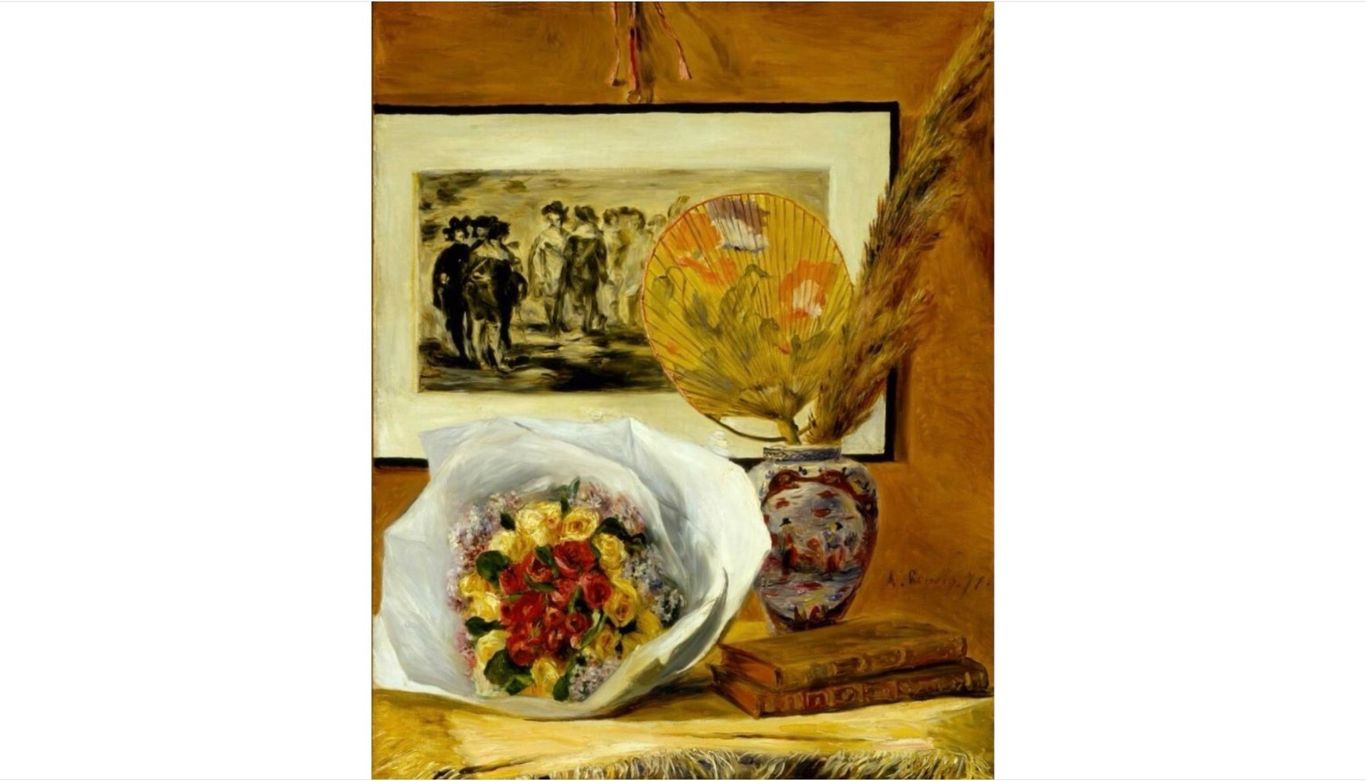
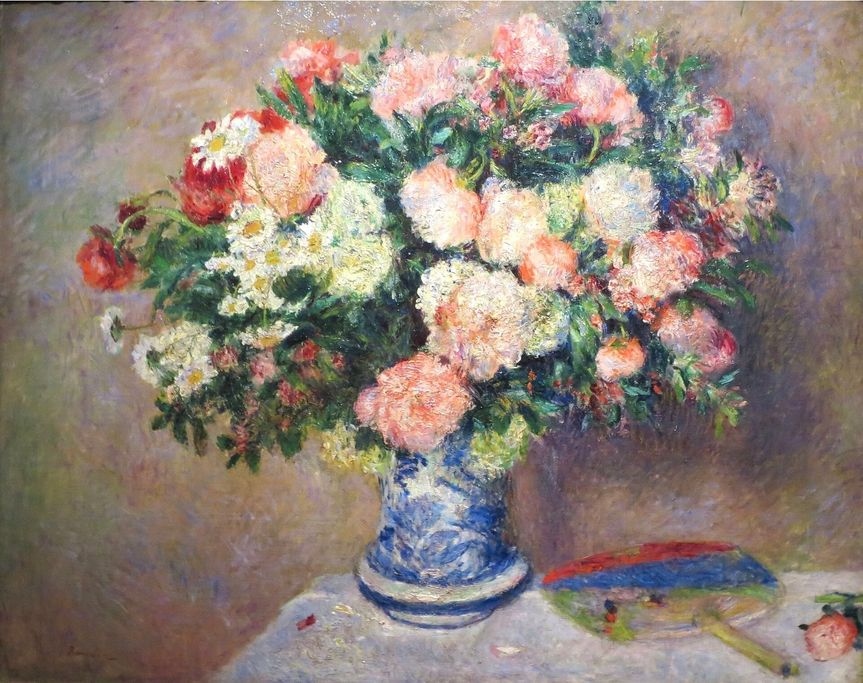
The above painting by Renoir was part of an exhibit on Japonisme in Cleveland back in August 1975, which an article in The New York Times describes thus: “At the very beginning of “Japonisme,” the exhibition that has drawn large and conspicuously attentive crowds to the Cleveland Museum of Art, there is a painting by Renoir that brings most visitors to a halt. It is dated 1871 and is quite unlike most people's idea of Renoir. The amiable hedonist of the female nudes is not in evidence. In his place is a man who is making an inventory of the objects he likes best. The painting is not so much built up as added to, and makes it clear that, at that moment in Renoir's career there were two sides to his creative personality a European side and Japanese side.”
The article finds an East-West symbolism within the painting, in a composition also conveying a related idea: “A dark print in a dark frame stands for Europe, in this context, together with two dusky old books in leather bindings and a large bouquet of flowers wrapped in white paper. In contrast to all this. Renoir included a Japanese fan and a Japanese pot - objects that, by their fresh, bright and stylized color, make quite a different impression. Renoir set all this on canvas not in a formal European way, but rather as Hokusai laid out his images in the “Manga,” a 15 volume sourcebook of images in woodcut, which had been current in Paris since the eighteen-fifties.” (‘On Art: Japonisme’ Stirring Cleveland’ by John Russell, The New York Times, Aug. 23, 1975:19)


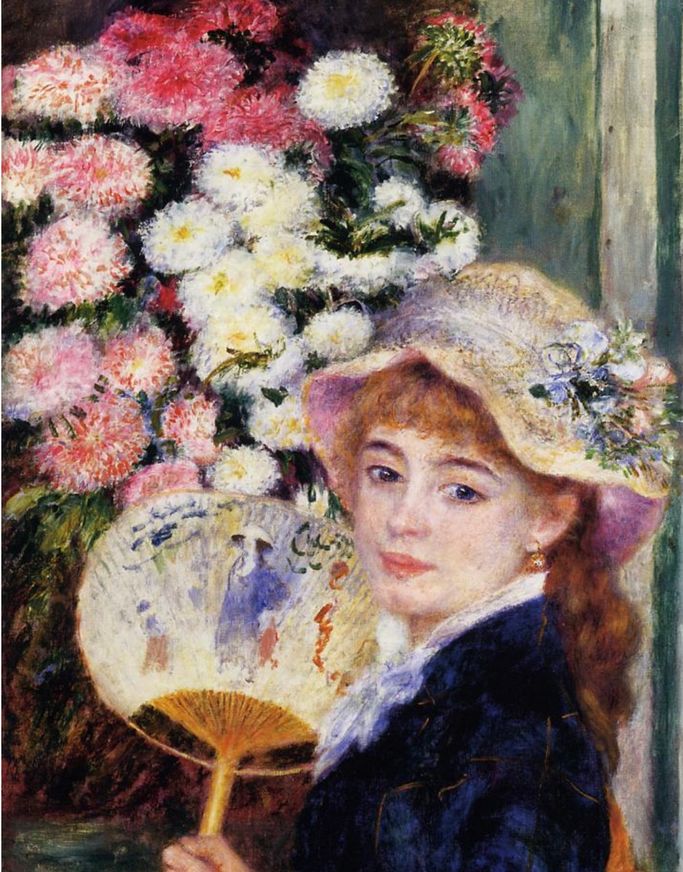
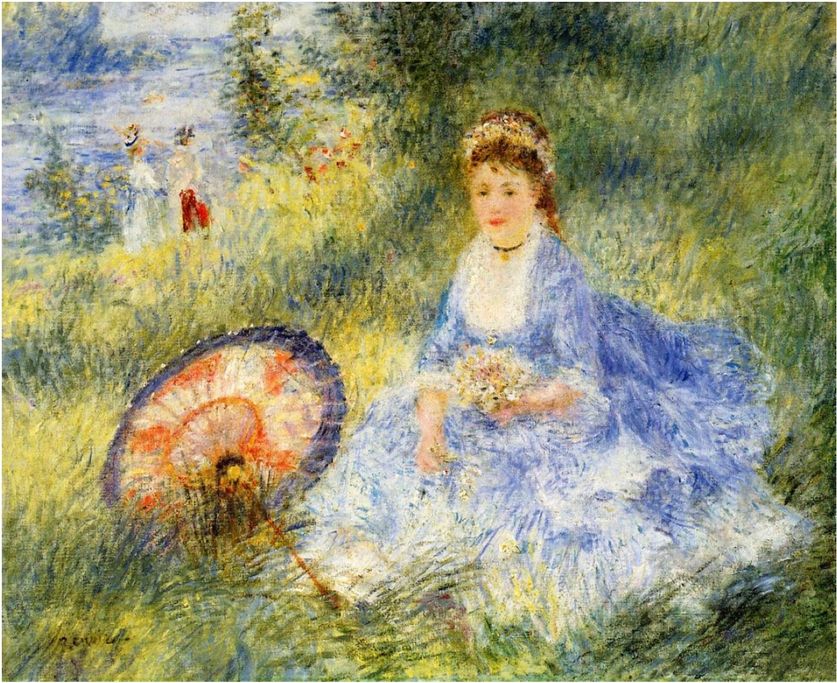
Saying in his notebook that "Young people should learn to see things for themselves, and not ask for advice" they should instead: "Look at the way the Japanese painted birds and fish. Their system is quite simple. They sat down in the countryside and watched birds flying. By watching them carefully, they finally came to understand movement; and they did the same as regards fish." So what is the footing and foundation of an artist? "An artist, under pain of oblivion, must have confidence in himself, and listen only to his real master: Nature." Tools are not important. Rather, it is observation of Nature as it is, which he explains by the following: "The Japanese still have a simplicity of life which gives them time to go about and to contemplate. They still look, fascinated, at a blade of grass, or the flight of birds, or the wonderful movements of fish, and they go home, their minds filled with beautiful ideas, which they have no trouble in putting on the objects they decorate."
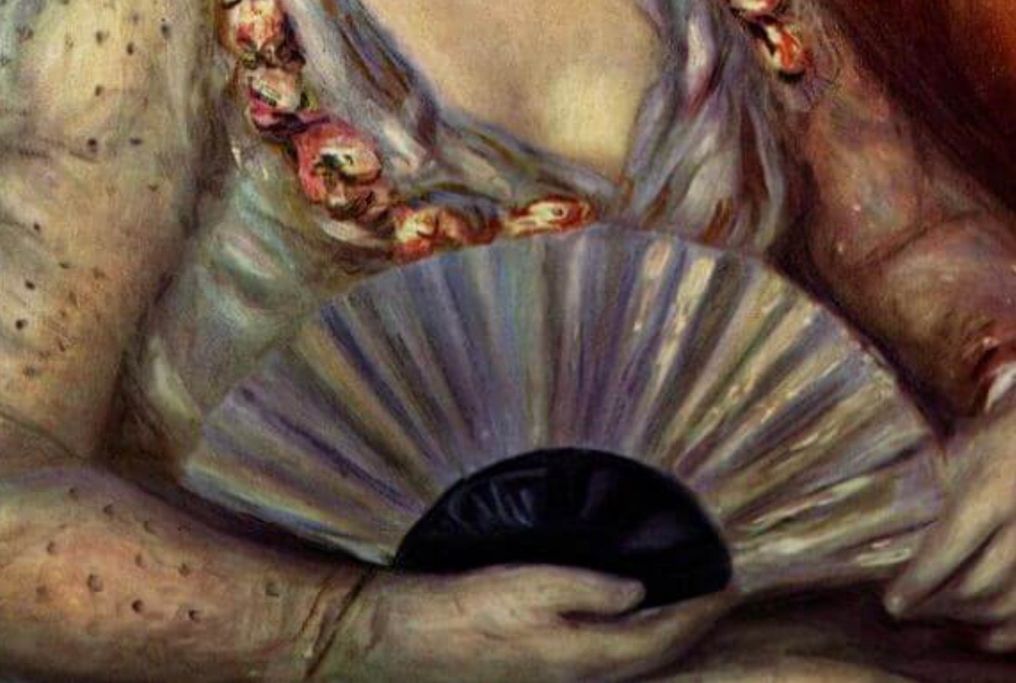
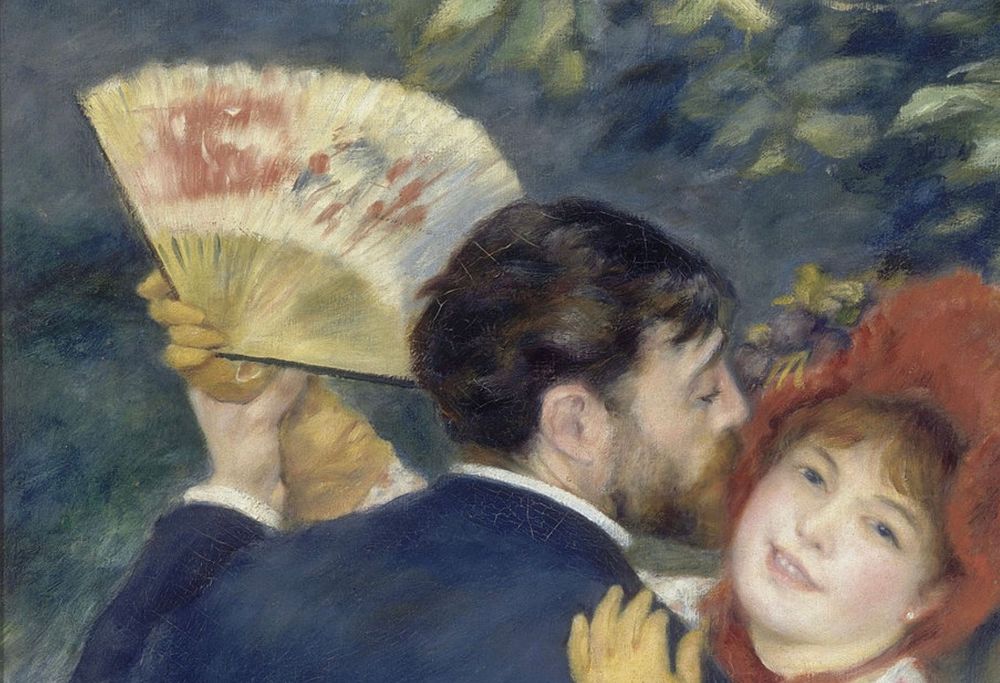
Seiji Oshima, director of the Tokyo Setagaya Art Museum, in his Japonisme. Impressionism and Ukiyo-e and their Milieu, devotes his 12th chapter entirely to Renoir, arguing that Renoir's japonisme is more profound than commonly believed. While acknowledging that “It is not easy to confirm Renoir had a special interest in Japanese prints” as his friends such as Monet had, Oshima points out that Renoir, having worked in a ceramic factory at an early age and later was involved in painting sensu-type fans, was most likely to have been in a position where he could acquire at least some knowledge of Oriental art.
We might add here that while this period of his life is often perfunctorily addressed as a time of primary Rococo style imitations, we should consider two things regarding this. Firstly that he spent a good number of years from the age of 13 to 18 engaged in this sort of work, which must be considered formative no matter how much one evolves later. And secondly, that the Rococo was itself in no small way a product of what is usually called ‘chinoiserie’ but was in reality a good part influenced by a ‘japonaiserie’ of porcelain, fans, lacquerware and kimonos imported from Japan (see on this website ‘18th century Japonisme’) with their own design and chromatic characteristics that set them apart from Chinese works, and that furthermore, trends in porcelain and fan making design were not immune to the wave of Japanese designs in those crafts entering Europe from the late 1850’s onward. That is to say, a Rococo design influence, especially in the crafts that Renoir was exposed to, were more intimately connected to the Far East, and most likely remained, as seen in his approach to color, on the level of his unexplicit thought and aesthetic sensibility.
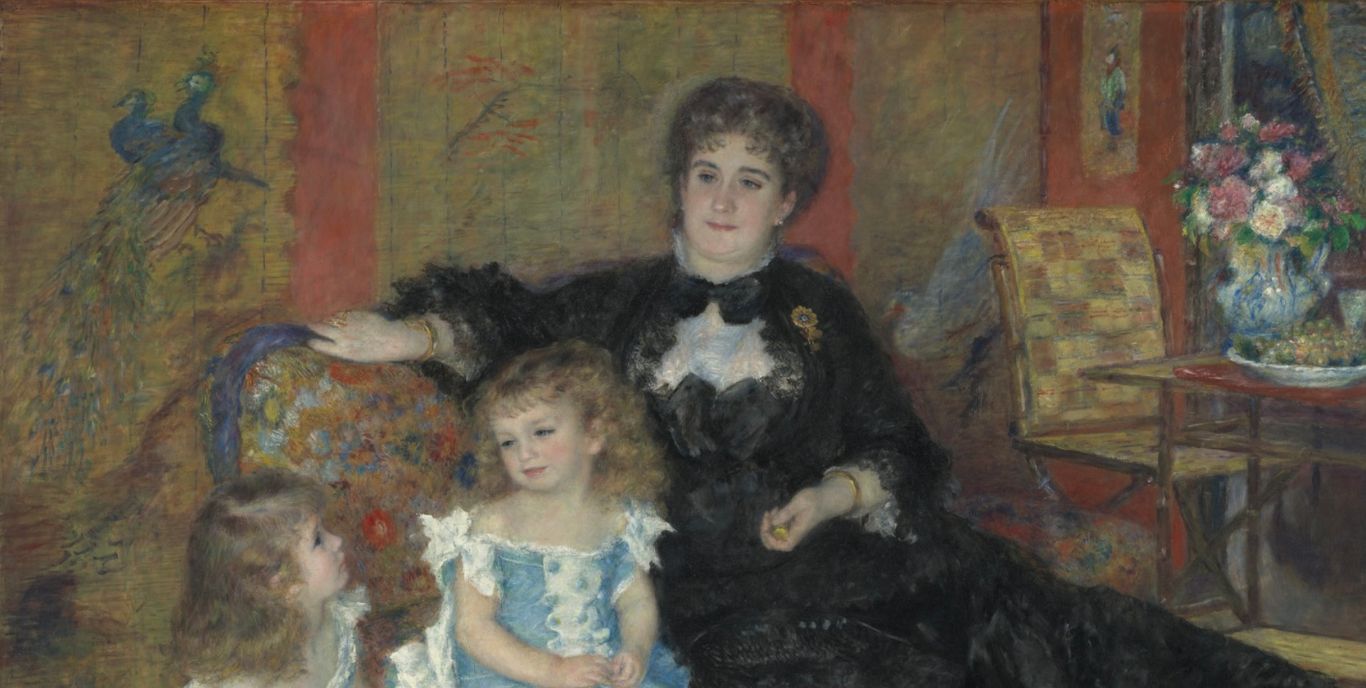
Throughout ‘From Auguste Renoir’s Notebook’ are ideas that are most often associated with the basic concepts of japonisme influence---such as asymmetry, which Renoir calls irregularity, and which is perhaps a more apt description of what Japanese art provided, since it was not really asymmetry as opposed to symmetry that Japanese are attempted, but more broadly conveying the irregularities of nature and spatial reality. A leaf that was part eaten by insects or part shriveled, part fresh, sprouting in unpredictable directions---this was more that just asymmetry. It is women fat or thin who are squatting or cutting their nails in the most awkward positions in compositions that center or ‘de-centers’ them---either is fine, and it is not really asymmetry which is categorically superior. Thus Renoir writes:
“Everything that I call grammar or primary notions of Art can be summed up in one word: Irregularity. … Take the leaf of a tree: take a hundred thousand other leaves of the same kind of tree: not one will exactly resemble another. ... Explain the irregularity in regularity. The value of regularity is in the eye only…the non-value to the regularity of the compass."
Perhaps the countless bijinga ukiyo-e 'beauties' which conveyed an image so contrary to the Greek ideal in almost every respect of racial and cultural composition--whether facial type and expression, anatomical make up, pose or poise, clothing and color---all of it, made it more easy for Renoir to conclude: "It is customary to prostrate oneself in front of the (obvious) beauty of Greek art. The rest has no value. What a farce! It is as if you told me that a blonde is more beautiful than a brunette; and vice versa.”
Might it not be Renoir then, who has better grasped the lesson of Japanese art, plumbed its depths, than his contemporaries well-known as Japonistes?
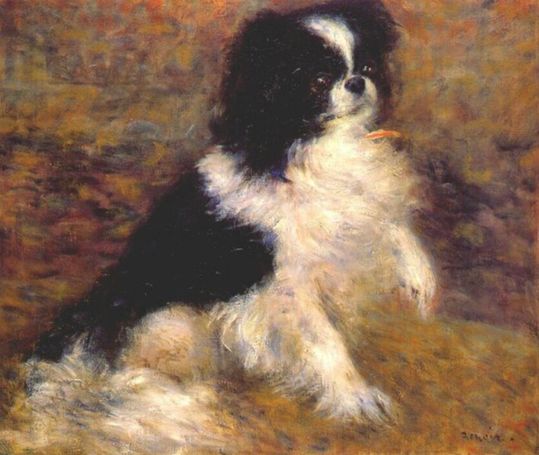
“In those days of our talks together, Renoir could express these principles with a certain confidence. In ferreting out the eternal lie, the illusions which conceal the reality of things, he had a long life of varied experiments to fall back on. He was at pains, moreover, to point out that his truth was far from being the ultimate truth.” He then quotes his father: "I've spent my life making blunders. The advantage of growing old is that you become aware of your mistakes more quickly." And he would say, also: "There isn't a person, a landscape, or a subject that doesn't possess at least some interest - although sometimes more or less hidden. When a painter discovers this hidden treasure, other people immediately exclaim at its beauty.”
And it is here that the opening quote of this discussion is found: “Old Corot opened our eyes to the beauty of the Loing, which is a river like any other; and I am sure that the Japanese landscape is no more beautiful than other landscapes. But the point is that Japanese painters knew how to bring out their hidden treasure." Auguste Renoir in Renoir, My Father by Jean Renoir (1962:222).